
Killing for Coal: America’s Deadliest Labor War
Winner of the 2009 Bancroft Prize
2009 Winner of the Bancroft Prize, Columbia University ✳︎ 2009 Winner of the Vincent P. DeSantis Prize, Society for Historians of the Gilded Age and Progressive Era ✳︎ 2009 Colorado Book Award, History ✳︎ 2009 Winner of the Caroline Bancroft History Prize, Denver Public Library ✳︎ 2009 Clark Spence Award, Mining History Association ✳︎ 2009 George Perkins Marsh Award, American Society for Environmental History
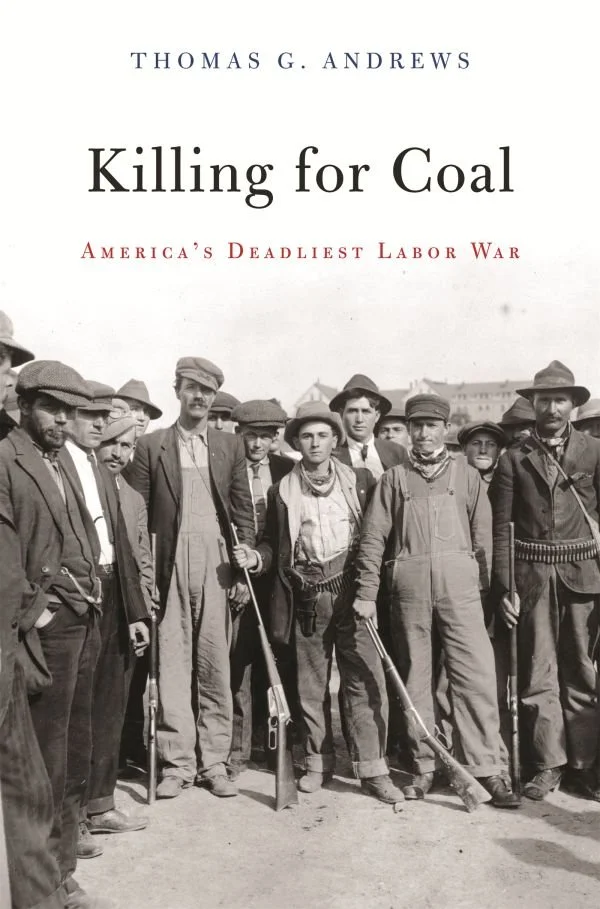
America’s Deadliest Labor War
On a spring morning in 1914, at a strikers’ tent colony perched amid the stark foothills near Ludlow, Colorado, members of the United Mine Workers clashed with mine guards employed by the Rockefeller family and a pliant state militia beholden to Colorado’s industrial oligarchs. By the time the fighting ended ten days later, the strikers’ losses amounted to more than twenty dead, most of them women and children asphyxiated as flames destroyed the colony. Fueled by decades of pent-up grievances, the strikers responded to this atrocity by waging a fierce guerrilla war that killed at least thirty strikebreakers, mine guards, and militiamen, destroyed six mines, and laid waste to two company towns.
Killing for Coal offers a bold and original perspective on the Ludlow-Massacre and the Great Coalfield War. In a sweeping story that begins in the coal beds and culminates with the deadliest strike in American history, Thomas Andrews examines the causes and consequences of the militancy that erupted in colliers’ strikes over the course of nearly half a century. He reveals a complex world shaped by the connected forces of land, labor, corporate industrialization, and workers’ resistance.
In the wake of the Civil War, the Quaker entrepreneur and Union veteran General William Jackson Palmer
Buy Here

What are people saying?
“A stunning debut, full of insight into the role of labor and class not just in southern Colorado, but across the country.”
— Westword
“Killing for Coal is far more than a blow-by-blow account of America's deadliest labor war. It is an environmental history that seeks to explain strike violence as the natural excretion of an industry that brutalized the earth and the men who worked beneath it.... Andrews deserves credit for writing one of the best books ever published on the mining industry and its environmental impact and for drawing more public attention to the Ludlow story and its significance.”
— James Green, Dissent
“Andrews brings a 21st-century approach to this once-troubled landscape where the region's voracious need for fuel trumped the rights and independence of the men who dragged it out of the ground.”
— Bob Hoover, Pittsburgh Post-Gazette
“Killing for Coal distinguishes itself from conventional labor histories, by going beyond sociological factors to look at the total physical environment--what Andrews calls the "workscape"--and the role it played in the lives of both labor and management...In its deft marriage of natural and social history, Killing for Coal sets a new standard for how the history of industry can and should be written.”
— Emily F. Popek, PopMatters
Civil War, Red and Bloody
THE SHOOTING started around nine o’clock on a bright, breezy morning in a broad valley where the broken foothills of the southern Rockies tumble down onto the high plains. No one has ever determined who shot first, but participants and witnesses all agree that within seconds of the initial gun blast, bullets began to fly thick and fast. Occupying the high ground was a small detachment of Colorado National Guardsmen…